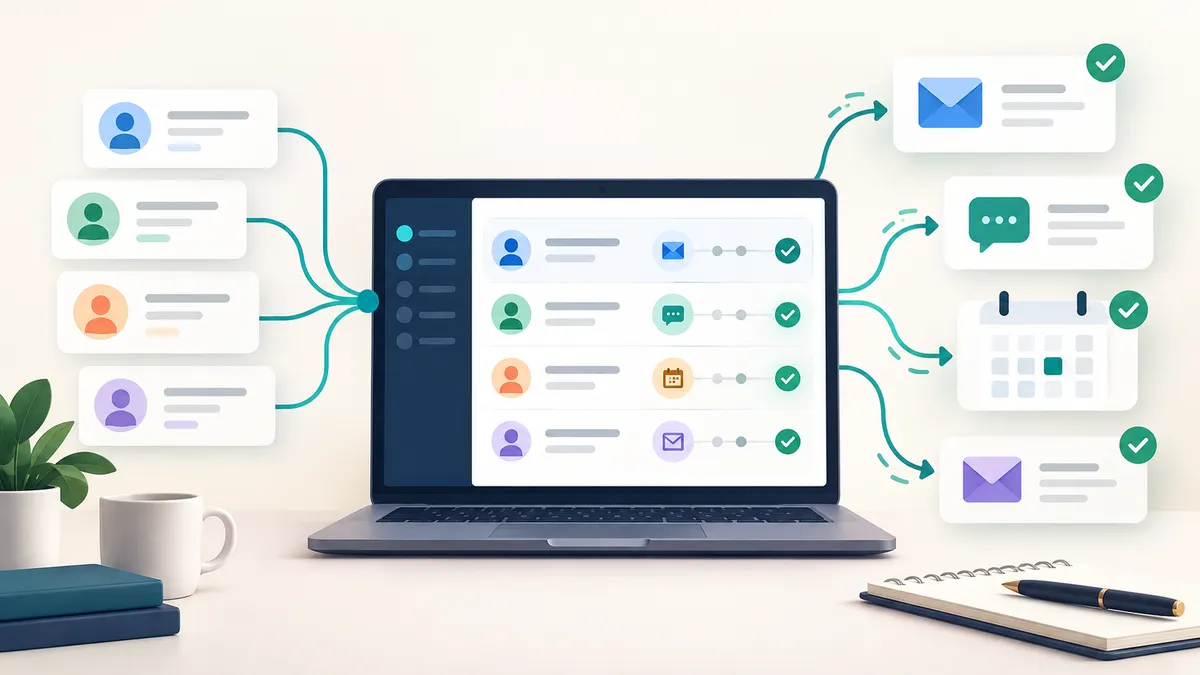
How to Automate Lead Follow-Up Without Hiring Staffg Post
Searched the web
How to Automate Lead Follow-Up Without Hiring Staff
You get a call at 4:45 on a Friday. By the time you’re back at your desk Monday, that lead has already talked to two of your competitors. Most small business owners know speed matters, but nobody on the payroll is paid to sit by the phone waiting on leads.
You don’t need to hire someone. You need a system that does the first 90% of follow-up for you.
Why follow-up is where Main Street loses
The business that responds first usually wins the job. Not the cheapest, not the best, just the first one to answer. Big competitors know this, so they’ve had automated follow-up for years. A plumber, HVAC company, med spa, or vet clinic with two or three people can’t match that by hand. Automation closes the gap.
Step 1: Respond in minutes, not hours
Every new lead, whether from a web form, missed call, Facebook ad, or Google listing, should get an instant text such as: “Hi Sarah, this is Mike at Smith Heating & Air. Got your request. What’s the best time today to call you?”
It’s short and personal, and it reaches them while they’re still holding the phone.
Step 2: Turn missed calls into conversations
A missed call is a lead you paid for and lost. Missed-call text-back sends an automatic message the moment you can’t pick up: “Sorry we missed you. We’re on a job. How can we help?” Many of these turn into booked appointments before you’ve even finished the job you were on.
Step 3: Build a simple follow-up sequence
Most leads don’t respond to the first message, so persistence matters. A basic sequence looks like this:
Minute 1: Instant text acknowledging the inquiry
Day 1: A friendly check-in
Day 3: A helpful message, such as a quick tip or answer to a common question
Day 7: A “still need help?” message
Day 14: A final, low-pressure touch
Once someone replies or books, the sequence stops automatically.
Step 4: Let the system book the appointment
Add a calendar link to your messages so leads can pick a time without phone tag. You show up to booked appointments instead of chasing people.
Step 5: Keep a human in the loop
Automation should handle the repetitive work, not replace you. When a lead replies with a real question, the system alerts you, and you step in. Customers get speed from the system and a real person when it counts.
Things to get right before you start
Get consent first. Texting leads is legal and effective, but federal law requires permission, and violations can cost $500 to $1,500 per message. The simplest approach is to collect consent on your forms and at booking.
Register your texting number. Carriers require business registration (called 10DLC) so your messages actually get delivered. Brand registration typically takes one to three business days and campaign registration two to seven.
Honor opt-outs. When someone says STOP, the system must stop, across every channel you use.
Mind the clock. Keep texts within allowed hours, generally between 8 a.m. and 9 p.m. in the recipient’s time zone.
The bottom line
Automated follow-up isn’t about being impersonal. It’s about making sure no lead goes cold because you were busy doing the work you’re good at. Set it up once, and it works nights, weekends, and holidays.
